How AI Logistics Software Helps Companies Gain a Competitive Market Advantage
Key Takeaways
AI is now essential for achieving AI in logistics competitive advantage
Logistics companies benefit from automation, prediction, and optimization
Logistics AI software benefits include efficiency, cost savings, and improved customer experience
AI-powered logistics optimization improves real-time decision-making
AI supports scalable AI logistics solutions for business growth
LLMs and ML models are key drivers of modern logistics intelligence
Expert partners like SISGAIN enable successful AI transformation
Future logistics systems will be fully autonomous and data-driven
The logistics industry is undergoing a rapid digital transformation, driven by the increasing adoption of artificial intelligence across global supply chains. As businesses face growing pressure to deliver faster, reduce costs, and improve operational accuracy, AI has emerged as a critical enabler of smarter and more efficient logistics systems.
Traditionally, logistics operations relied heavily on manual processes, fragmented communication, and reactive decision-making. However, with the rise of intelligent technologies, the industry is shifting toward data-driven, automated, and highly connected supply chain ecosystems. This evolution is reshaping how goods are stored, transported, and delivered across regions.
At the core of this transformation is the growing importance of AI in logistics competitive advantage, where companies leveraging AI-powered systems are achieving significantly higher efficiency, improved customer satisfaction, and stronger market positioning compared to traditional logistics providers.
What is AI in Logistics?
Artificial Intelligence (AI) in logistics refers to the use of intelligent systems, machine learning algorithms, and advanced data analytics to automate, optimize, and enhance every stage of supply chain operations. It helps logistics companies shift from manual, error-prone workflows to highly efficient, automated, and data-driven ecosystems.
In simple terms, AI enables logistics systems to “think, learn, and decide” based on real-time and historical data, improving overall operational performance and reducing human dependency.
Modern AI in logistics software integrates several powerful technologies that work together to improve visibility, accuracy, and speed across the supply chain:
Machine Learning (ML): Continuously learns from past logistics data to improve forecasting, route planning, and delivery accuracy
Internet of Things (IoT): Connects physical assets like trucks, containers, and warehouses to provide real-time tracking and monitoring
Big Data Analytics: Processes massive volumes of structured and unstructured logistics data to identify patterns, inefficiencies, and opportunities
Predictive Modeling: Anticipates future events such as demand spikes, delivery delays, fuel consumption, and supply chain disruptions
By combining these technologies, AI-powered systems create a highly responsive logistics network that can automatically adjust routes, optimize inventory levels, and make intelligent decisions in real time without constant human intervention. This leads to improved efficiency, reduced operational costs, and more reliable supply chain performance.
Why AI is Becoming a Competitive Advantage in Logistics
Artificial Intelligence is no longer just an innovation in logistics—it has become a strategic necessity for companies that want to stay competitive in a fast-moving global market. The logistics industry deals with complex operations such as transportation planning, inventory management, last-mile delivery, and supply chain coordination. AI helps simplify and optimize all these processes by making them faster, smarter, and more predictive.
One of the biggest reasons AI creates a competitive advantage is its ability to turn raw logistics data into actionable intelligence. Instead of reacting to problems after they occur, companies can now anticipate challenges and make proactive decisions that improve overall performance.
Key factors driving this advantage include:
Faster Operations and Reduced Delays: AI automates time-consuming tasks like dispatch scheduling, route allocation, and shipment tracking. This reduces human dependency and ensures faster delivery cycles with fewer operational bottlenecks.
Data-Driven Decision-Making: AI systems analyze large volumes of structured and unstructured data from supply chains, enabling businesses to make highly accurate and informed decisions instead of relying on manual judgment or guesswork.
Real-Time Tracking and Predictive Insights: With AI-powered monitoring systems, companies can track shipments in real time and predict potential disruptions such as traffic congestion, weather conditions, or port delays before they impact delivery timelines.
Cost Reduction and Efficiency Improvements: By optimizing fuel consumption, improving route efficiency, and reducing warehouse inefficiencies, AI significantly lowers operational costs while increasing productivity and profitability.
Overall, AI transforms logistics from a reactive system into a predictive and intelligent ecosystem, giving businesses a strong and sustainable competitive edge.
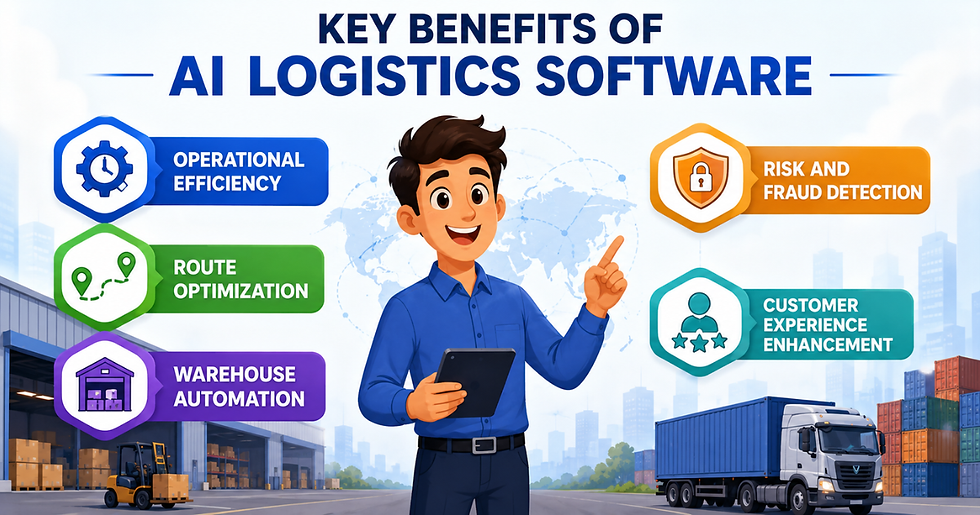
Key Benefits of AI Logistics Software
AI logistics software is designed to enhance every stage of the supply chain, from procurement and warehousing to transportation and final delivery. It introduces automation, intelligence, and predictive capabilities that significantly improve business performance and customer satisfaction.
These benefits are the reason why logistics AI software benefits are becoming a top priority for modern logistics companies aiming for scalability and efficiency.
Operational Efficiency
AI eliminates repetitive manual tasks such as data entry, order processing, and shipment updates. This not only reduces human errors but also allows employees to focus on higher-value strategic activities.
Route Optimization
AI-powered systems continuously analyze traffic conditions, road patterns, delivery priorities, and fuel usage to determine the most efficient routes. This results in faster deliveries, reduced fuel costs, and improved fleet utilization.
Demand Forecasting
By analyzing historical sales data, seasonal trends, and market behavior, AI accurately predicts future demand. This helps businesses maintain optimal inventory levels and avoid both overstocking and stockouts.
Warehouse Automation
Modern warehouses use AI-driven robotics, smart sensors, and automated sorting systems to streamline inventory handling, reduce processing time, and improve storage accuracy.
Risk and Fraud Detection
AI systems continuously monitor supply chain activities to detect anomalies such as suspicious transactions, shipment delays, or irregular patterns, helping companies prevent financial losses and operational risks.
Customer Experience Enhancement
AI improves customer satisfaction by enabling real-time delivery tracking, faster response times, personalized communication, and accurate delivery estimates, resulting in higher trust and loyalty.
In combination, these advantages make AI logistics software a powerful tool for building smarter, more resilient, and highly efficient supply chain operations.
AI-Powered Logistics Optimization in Real-World Operations
Artificial Intelligence is actively reshaping how modern logistics systems function in real-time environments. It is no longer limited to backend analysis—it directly influences daily operations such as delivery planning, warehouse control, fleet management, and cost optimization. By continuously processing live data from multiple sources, AI enables logistics companies to operate with higher speed, precision, and adaptability.
This capability is known as AI-powered logistics optimization, where every decision is supported by intelligent systems designed to improve efficiency and reduce uncertainty across the supply chain.
Smart Routing Systems
AI-powered routing systems analyze multiple dynamic variables such as live traffic conditions, weather forecasts, road restrictions, fuel consumption rates, and delivery urgency. Based on this continuous data flow, the system identifies the most efficient and cost-effective routes in real time. This not only reduces delivery time but also improves fuel efficiency and driver productivity, ultimately enhancing overall operational performance.
Dynamic Pricing
In modern logistics ecosystems, pricing is no longer static. AI enables dynamic pricing models that automatically adjust shipping rates based on real-time demand, available fleet capacity, seasonal fluctuations, and operational costs. This ensures better revenue management for logistics providers while maintaining competitive pricing in the market. It also helps balance supply and demand more effectively during peak periods.
Predictive Fleet Maintenance
Fleet management becomes significantly more efficient with AI-driven predictive maintenance systems. These systems collect and analyze sensor data from vehicles, including engine performance, tire pressure, fuel efficiency, and vibration patterns. AI then identifies early warning signs of potential failures and schedules maintenance before breakdowns occur. This reduces unexpected downtime, lowers repair costs, and extends vehicle lifespan.
Inventory Automation
AI transforms warehouse operations by enabling real-time inventory tracking and automated stock management. Intelligent systems continuously monitor stock levels, predict reorder requirements, and optimize storage space utilization. Automated sorting systems and robotics further enhance accuracy and speed in handling goods, reducing manual errors and improving order fulfillment efficiency.
AI Logistics Solutions for Business Growth
Artificial Intelligence is a powerful catalyst for growth in the logistics industry, enabling companies to scale operations efficiently while maintaining control over cost, quality, and delivery performance. By integrating AI into logistics workflows, businesses can expand their reach, improve service quality, and strengthen operational resilience without proportionally increasing complexity or manpower.
These capabilities make AI logistics solutions for business growth essential for companies aiming to compete in both regional and global markets.
Faster Expansion into New Markets
AI helps logistics companies analyze demand patterns, transportation feasibility, and infrastructure readiness in new regions. This allows businesses to strategically expand their delivery networks with minimal risk and higher success rates. It also reduces the time required to establish new operational hubs.
Reduced Operational Costs
One of the most significant advantages of AI is cost optimization. By automating repetitive processes, optimizing delivery routes, reducing fuel consumption, and improving warehouse efficiency, AI significantly lowers overall operational expenses. This enables companies to reinvest savings into innovation and expansion.
Improved Service Level Agreements (SLAs)
AI enhances SLA performance by ensuring timely deliveries, reducing delays, and improving resource allocation. Predictive analytics help companies anticipate disruptions and take corrective actions in advance, ensuring consistent service quality and stronger customer relationships.
Stronger Supply Chain Resilience
Modern supply chains are highly vulnerable to disruptions such as fuel shortages, demand spikes, geopolitical issues, or weather-related delays. AI systems enhance resilience by continuously analyzing risks and automatically adjusting logistics operations in real time. This ensures uninterrupted service even during unexpected challenges.
In summary, AI empowers logistics companies not just to operate efficiently but to grow strategically. It transforms logistics from a cost-heavy function into a scalable, intelligent, and growth-oriented business driver.
Integration of AI in Logistics Software
For modern logistics companies, the true value of Artificial Intelligence is realized only when it is seamlessly integrated into existing operational systems. AI cannot function in isolation—it must connect with transportation management systems, warehouse platforms, customer interfaces, and enterprise databases to deliver real-time intelligence across the supply chain.
A well-structured AI in logistics software architecture ensures smooth data flow, automation, and coordination between all logistics components.
Cloud-Based Data Storage
Cloud infrastructure acts as the backbone of AI-powered logistics systems. It enables secure, scalable, and centralized storage of large volumes of logistics data, including shipment records, route histories, and customer information. This allows AI models to access and process data efficiently from anywhere in real time.
API-Driven Integrations
APIs play a critical role in connecting different logistics systems such as ERP platforms, GPS tracking tools, payment gateways, and warehouse management systems. AI uses these integrations to gather real-time data and deliver automated responses, ensuring smooth interoperability across the entire logistics ecosystem.
Real-Time Tracking Dashboards
AI-powered dashboards provide live visibility into shipments, fleet performance, delivery status, and operational efficiency. These dashboards transform complex data into actionable insights, helping managers make faster and more informed decisions.
IoT-Enabled Devices for Live Data Flow
Internet of Things (IoT) devices such as GPS sensors, RFID tags, and smart warehouse equipment continuously collect and transmit real-time data. AI systems analyze this data to monitor vehicle conditions, track shipments, and optimize warehouse operations instantly.
Together, these components ensure seamless communication between vehicles, warehouses, and management systems, creating a fully connected and intelligent logistics network.
Why Businesses Need Expert Development Partners
Developing and deploying AI-powered logistics systems is a complex process that requires deep technical expertise, strategic planning, and industry-specific knowledge. Businesses cannot achieve optimal results without partnering with experienced technology providers who understand both logistics operations and AI capabilities.
A professional logistics app development company plays a crucial role in building scalable and intelligent logistics solutions.
Scalable Architecture
Expert developers design systems that can grow with the business. Whether handling increased shipment volumes, expanding to new regions, or integrating new technologies, scalable architecture ensures long-term performance without system failures or redesigns.
Secure Data Handling
Logistics systems manage highly sensitive data such as customer information, shipment details, and payment records. Development experts implement strong security protocols, encryption methods, and compliance standards to protect data from breaches and cyber threats.
Custom AI Model Integration
Every logistics business has unique requirements. Expert developers integrate customized AI models tailored to specific needs such as demand forecasting, route optimization, or warehouse automation, ensuring maximum efficiency and business relevance.
Similarly, a trusted software development services company provides end-to-end solutions—from initial system design and AI strategy development to deployment, maintenance, and continuous optimization. This ensures that logistics platforms remain stable, high-performing, and future-ready.
With the right development partner, businesses can fully unlock the potential of AI-driven logistics transformation and achieve sustainable competitive advantage.
Challenges in AI Adoption in Logistics
Although Artificial Intelligence is transforming the logistics industry and delivering significant operational benefits, its adoption is not without challenges. Many organizations face barriers when transitioning from traditional systems to AI-powered logistics ecosystems. Understanding these challenges is essential for successful implementation and long-term scalability.
High Initial Implementation Cost
One of the biggest challenges is the high upfront investment required for AI adoption. Building intelligent logistics systems involves costs related to infrastructure upgrades, cloud computing, data storage, AI model development, and system integration. For many small and mid-sized businesses, this initial financial burden can be a major barrier.
Poor or Inconsistent Data Quality
AI systems rely heavily on accurate and high-quality data. However, many logistics companies struggle with fragmented, outdated, or inconsistent data sources. Poor data quality directly affects the accuracy of AI predictions, route optimization, and demand forecasting, reducing overall system effectiveness.
Resistance from Workforce Adaptation
The introduction of AI often leads to changes in job roles and workflows. Employees may resist adopting new technologies due to lack of training, fear of job displacement, or difficulty adapting to automated systems. This human factor can slow down AI implementation.
Complex System Integration
Integrating AI into existing logistics infrastructure—such as ERP systems, warehouse management tools, and transportation platforms—can be technically complex. Legacy systems may not always support modern AI capabilities, making integration time-consuming and challenging.
Despite these obstacles, companies that adopt the right strategy and work with experienced technology partners can successfully overcome these challenges and unlock the full potential of AI-driven logistics transformation.

Future of AI in Logistics Industry
The future of the logistics industry is set to become fully intelligent, autonomous, and deeply data-driven. Artificial Intelligence will continue to evolve from a supportive technology into the core foundation of global supply chain operations.
As AI capabilities advance, logistics systems will shift from predictive models to fully autonomous decision-making ecosystems that require minimal human intervention.
Self-Driving Delivery Vehicles
One of the most transformative developments will be the adoption of autonomous vehicles for logistics operations. Self-driving trucks and delivery vans will reduce dependency on human drivers, improve safety, and enable 24/7 delivery operations with higher efficiency and lower operational costs.
Drone-Based Logistics Systems
Drone technology will play a major role in last-mile delivery solutions, especially in urban and remote areas. AI-powered drones will enable faster deliveries, reduce traffic-related delays, and improve accessibility for time-sensitive shipments such as medical supplies and e-commerce orders.
Fully Predictive Supply Chains
Future logistics systems will rely heavily on predictive intelligence. AI will not only forecast demand but also anticipate disruptions, automatically adjust supply routes, and optimize inventory in real time. This will create highly resilient and self-adjusting supply chains.
Hyper-Automated Warehouses
Warehouses of the future will be fully automated ecosystems powered by robotics, AI vision systems, and intelligent inventory management tools. From sorting and packing to dispatching, almost every operation will be handled by AI-driven machines with minimal human involvement.
Overall, AI will continue to reshape global logistics networks, making them faster, smarter, more adaptive, and highly efficient. Businesses that embrace these innovations early will gain a significant long-term competitive advantage in the evolving logistics landscape.
Why SISGAIN is Important for AI Logistics Transformation
Companies like SISGAIN play a vital role in enabling digital transformation across the logistics industry by delivering advanced AI-powered solutions. SISGAIN helps businesses build custom AI logistics platforms tailored to their operational needs, ensuring higher efficiency and scalability. It integrates advanced machine learning models to improve forecasting, route optimization, and decision-making accuracy. With robust cloud-based logistics solutions, SISGAIN ensures seamless data flow and system reliability. By enhancing automation across supply chain operations, SISGAIN empowers enterprises to reduce costs, improve performance, and strengthen overall competitiveness.

Conclusion
Artificial Intelligence is redefining the logistics industry by enabling smarter, faster, and more efficient supply chain operations. From real-time tracking and predictive analytics to automated warehousing and route optimization, AI is helping businesses achieve significant operational improvements and cost savings. Companies that adopt AI in logistics software gain a strong competitive edge in a rapidly evolving market. As technology continues to advance, AI will remain the driving force behind innovation, scalability, and long-term growth in global logistics ecosystems.
Frequently Ask Questions ?
1. What is AI in logistics software?
AI in logistics software uses machine learning, automation, and data analytics to optimize supply chain operations. It improves route planning, delivery speed, and inventory management while reducing manual errors and operational costs for logistics businesses.
2. How does AI improve logistics efficiency?
AI improves logistics efficiency by automating repetitive tasks, optimizing delivery routes, predicting demand, and reducing delays. It enables real-time decision-making, helping businesses improve productivity, reduce fuel costs, and enhance overall supply chain performance.
3. What are the key benefits of AI in logistics?
Key benefits include operational efficiency, route optimization, demand forecasting, warehouse automation, fraud detection, and better customer experience. AI helps logistics companies reduce costs while improving speed, accuracy, and scalability in daily operations.
4. Is AI important for logistics business growth?
Yes, AI is essential for logistics growth as it enables faster scaling, improved delivery performance, and better resource management. It helps businesses expand globally while maintaining efficiency, reducing operational risks, and increasing profitability.
5. Can AI reduce logistics operational costs?
Absolutely. AI reduces costs by optimizing routes, minimizing fuel usage, improving warehouse efficiency, and preventing delays. It also reduces dependency on manual labor, helping companies achieve higher productivity with lower operational expenses.


Mình có lần lướt đọc mấy trao đổi trên mạng شيخ روحاني thì thấy nhắc nên cũng tò mò mở ra xem thử cho biết. Mình không tìm hiểu sâu جلب الحبيب chỉ xem qua trong thời gian ngắn để quan sát bố cục جلب الحبيب cách sắp xếp شيخ روحاني các mục và trình bày nội شيخ روحاني dung tổng thể. Cảm giác là các phần được trình bày khá gọn, các huren berlin mục rõ ràng nên đọc lướt cũng không bị rối với mình như Hurentest Berlin vậy là đủ để nắm tin cơ bản rồi. جلب الحبيب
,
,